Texas Hold'em Strategy for Beginners
Good poker strategy starts with understanding the strength of your hand,
your position at the table, the action before you and the cards that
could improve your hand.
There is no single strategy that guarantees a win in poker. Instead,
players use information, probability and disciplined decision-making
to choose between folding, calling, checking, betting and raising.
1. Learn the Poker Hand Rankings
Before learning advanced strategy, make sure you know the poker hand
rankings. Understanding the difference between a pair, two pair, a
straight, a flush and stronger hands is essential.
View Poker Hand Rankings
2. Choose Strong Starting Hands
Your two hole cards are an important starting point in Texas Hold'em.
Some starting hands are much stronger than others before the flop.
Premium hands such as pocket Aces, pocket Kings and Ace-King can often
be played aggressively, while weaker hands may be better candidates
for folding.
Beginners should avoid playing too many hands simply because they look
interesting. Folding before the flop is a normal and important part of
poker.
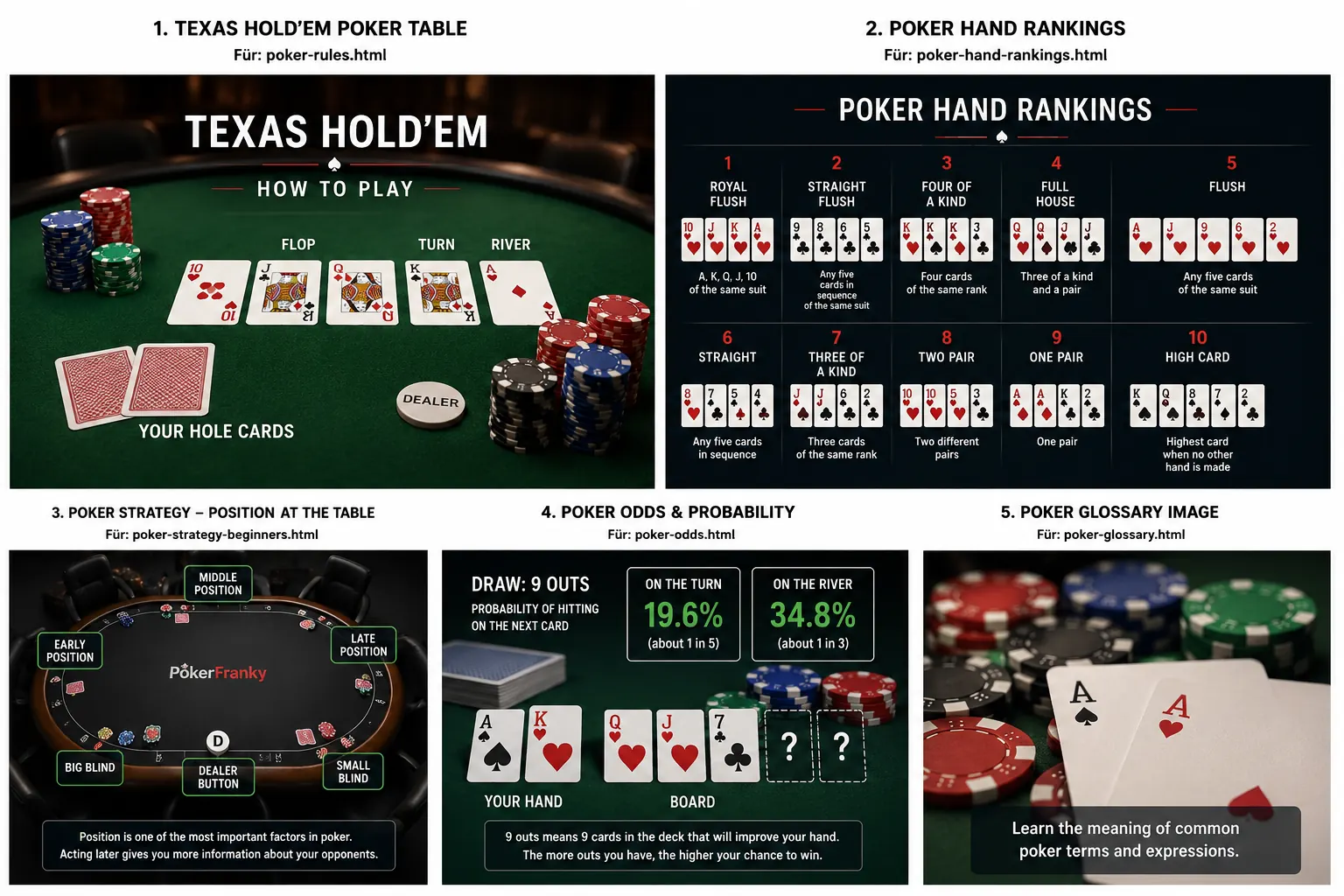
3. Understand Position
Position describes where you act relative to the other players.
Players who act later in a betting round generally have more information
because they can see what opponents have done first.
Early Position
Acting early can be difficult because several players are still able to
act after you.
Late Position
Acting later can provide more information about opponents' decisions.
Dealer Button
The button is one of the most useful positions because it normally acts
late after the flop.
4. Play More Carefully from Early Position
When you act early, there are more players who can potentially call,
raise or re-raise after you. This makes marginal hands harder to play.
For beginners, a tighter range of starting hands from early position
can make decisions simpler.
5. Be More Active in Late Position
Late position gives you more information about the actions of other
players. If several opponents have already folded, there may also be
fewer players competing for the pot.
This does not mean every late-position hand should be played. Position
is an advantage, but hand strength and the previous action still matter.
6. Understand the Pre-Flop Action
Before the flop, players must decide whether to fold, call or raise.
The decision should consider your starting hand, position, previous
action and the likely range of your opponents.
Calling is not automatically better than raising. In some situations,
raising can put pressure on weaker hands and help define the strength
of an opponent's range.
7. Think About Ranges
A range is the collection of hands an opponent could reasonably have.
Instead of trying to guess one exact hand, beginners can think about
which groups of hands are possible.
The betting action, position and community cards can all provide clues
about an opponent's possible range.
8. Use the Community Cards Carefully
The flop, turn and river can change the strength of your hand and the
possible hands your opponents may have.
Always consider whether the community cards create possible straights,
flushes or other strong combinations.
A strong hand on the flop is not necessarily a strong hand on the
river. The board can change considerably during the hand.
9. Understand Betting
Betting is more than simply putting chips into the pot. The size and
timing of a bet can communicate information and influence the decisions
of other players.
Value Betting
Betting when you believe you have a strong hand that can be called by
weaker hands.
Bluffing
Betting or raising with a weaker hand in an attempt to make an opponent
fold.
Checking
Passing the action without betting when no bet is required.
10. Do Not Bluff Too Much
Bluffing is an important part of poker, but beginners often make the
mistake of bluffing too frequently.
A bluff is more useful when there is a reasonable chance that an
opponent will fold. Consider the board, your perceived range, your
opponent's likely range and the previous action before attempting a
bluff.
11. Learn About Poker Odds
Poker decisions often involve probability. Understanding outs, pot
odds and equity can help you evaluate whether continuing with a hand
may be mathematically reasonable.
These concepts take time to learn, so beginners should start with the
basics rather than trying to memorise complicated calculations.
Learn Poker Odds
12. Know Your Outs
An out is a card that can improve your hand to a potentially winning
hand. For example, if you need one more card of a particular rank to
complete a straight, those cards may be considered outs.
Counting outs can help you estimate the probability of improving your
hand.
13. Understand Pot Odds
Pot odds compare the cost of calling with the amount you could win from
the pot.
For example, if the pot is £100 and you must call £20, the call costs
20% of the final amount you would receive if you win. Comparing pot odds
with your estimated chance of completing a winning hand can help with
decision-making.
This is a simplified example. Actual poker decisions can also depend
on implied odds, future betting and the strength of your opponent's
range.
14. Avoid Common Beginner Mistakes
Playing Too Many Hands
You do not need to enter every pot. Folding weak starting hands is a
normal part of good poker.
Ignoring Position
The same hand can be easier or harder to play depending on where you
are sitting.
Chasing Every Draw
A possible straight or flush does not automatically justify calling a
bet. Consider the odds and the cost.
Calling Too Often
Passive play can make it difficult to win pots and may allow opponents
to control the action.
Ignoring the Board
Always consider how the community cards may have improved your
opponent's possible hands.
Chasing Losses
Avoid increasing stakes simply because you have lost previous hands.
Each decision should be considered independently.
15. Keep Decisions Simple
Beginners do not need to master every advanced poker concept immediately.
A strong foundation comes from learning hand rankings, starting hands,
position, basic betting and simple probability.
As your understanding improves, you can gradually study more advanced
concepts such as ranges, equity, implied odds and post-flop strategy.
Simple Poker Strategy Checklist
Before the Flop
Consider your starting hand, position and the action before you.
On the Flop
Consider your hand strength, the board texture and possible draws.
On the Turn
Re-evaluate your hand because the additional community card can change
the situation significantly.
On the River
Consider the final board, your opponent's likely range and whether
betting, calling or folding makes the most sense.
Think About Ranges
Do not focus only on one possible opponent hand. Consider the range of
hands they could have.
Stay Disciplined
Avoid emotional decisions and do not chase losses.
Learn More About Texas Hold'em
Poker strategy becomes easier to understand once the basic rules,
hand rankings and poker odds are familiar.
Poker Rules
Learn how Texas Hold'em works from the deal through the showdown.
Read Poker Rules
Poker Odds
Learn about outs, probability, equity and pot odds.
Read Poker Odds
Responsible Poker
Poker involves risk and there is no strategy that guarantees a profit.
Only play with money you can afford to lose and consider setting
personal limits on time and spending.
Read our Responsible Gambling Guide
 Poker Hand Rankings
Poker Odds